
AWS Multi-party Approval for Organizations
Multi-party approval in AWS Organizations gates high-risk operations behind a quorum of human approvers. Here is how it works and the security it buys.
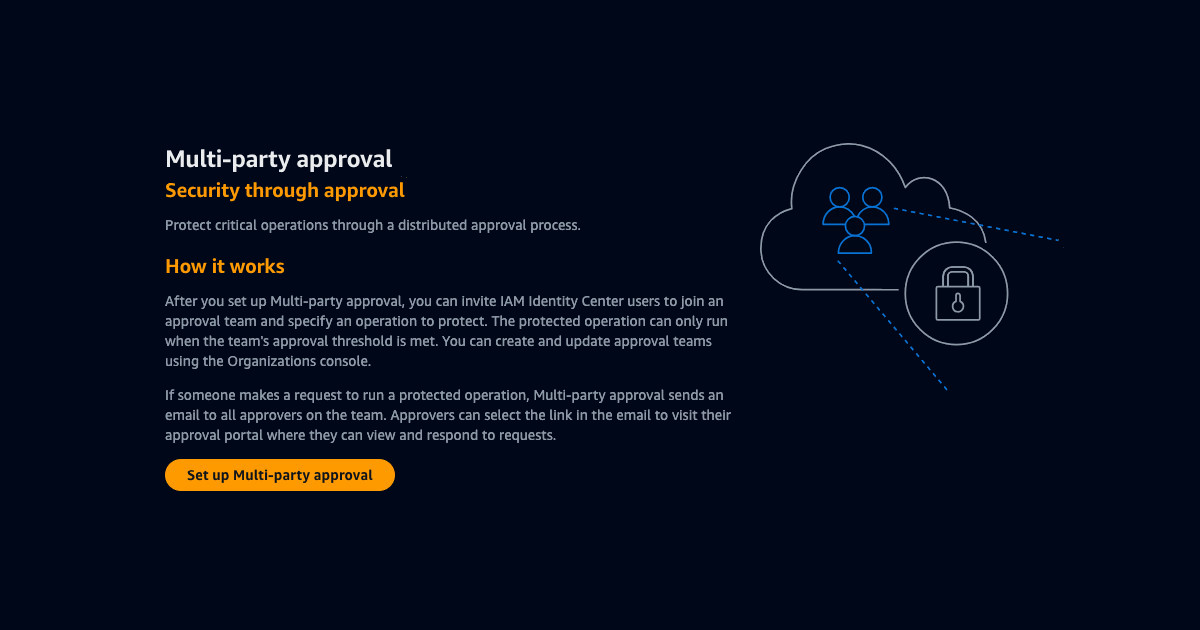
Multi-party approval is a capability of AWS Organizations that blocks a predefined set of high-risk operations until a quorum of named humans approves them out of band. A single set of credentials, even a valid one, can no longer pull the trigger alone. The requester starts the action, a separate approval team reviews it in a dedicated portal, and the operation only runs once the team's approval threshold is met.
This is the "four eyes" principle enforced at the API layer instead of in a runbook or a Slack message. It closes the gap between "we have a policy that says two people must sign off" and "the platform physically refuses to proceed without two sign-offs."
What it actually is
Multi-party approval (MPA) sits inside AWS Organizations and depends on IAM Identity Center for the human identities. You define an approval team, a set of approvers drawn from your identity source, and you attach an approval threshold: the minimum number of those people who must say yes before a protected operation can run.
You then mark specific operations as protected. From that point on, anyone who invokes a protected operation does not get an immediate result. They get a pending request. MPA emails every approver on the team, each approver opens the approval portal, reviews the request, and approves or denies it. Once the threshold is reached, the original caller's operation is allowed to proceed. The approval is the gate, not a notification after the fact.
The vocabulary
- Approval team: a named group of approvers, backed by IAM Identity Center users.
- Approval threshold: how many approvers must approve. A team of three with a threshold of two means any two of them unblock the action.
- Protected operation: the specific action you have placed behind the gate.
- Approval portal: the out-of-band surface where approvers review and respond. It is deliberately separate from the console session that made the request.
How the flow works
The process is three steps, and the separation between them is the whole point.
- Request. A user (or an automated caller) invokes a protected operation. Instead of executing, AWS creates an approval session and notifies the team.
- Approval session. Approvers receive an email with a link, open the portal, and see exactly what is being requested, by whom, and against which resource. They approve or deny independently.
- Execution. When approvals reach the threshold, the operation runs. If the session times out or the threshold is never met, the operation never happens.
The requester cannot approve their own request from inside their own session. Approval happens in a different surface, tied to different identities. That is what makes a stolen session token or a compromised CI role insufficient on its own.
Why it matters for security
The value is not the email or the portal. It is that the control lives below the application, in the platform, where a single compromised principal cannot route around it.
It removes the single point of compromise
Most catastrophic cloud incidents come down to one identity with too much reach: a leaked long-lived key, a phished admin, an over-scoped automation role. For the handful of operations that can ruin your week, MPA turns "one compromised credential" into "you also need to subvert N independent humans at the same time." That is a different class of attack.
It enforces separation of duties at the API
Separation of duties usually lives in a compliance document and dies in practice, because nothing stops a hurried engineer from doing both halves of a sensitive change. MPA moves the rule into the control plane. The platform, not goodwill, enforces the second signature.
It is a brake against ransomware and destructive insiders
The classic destructive playbook is to delete the backups first, then the data. If the operations that delete or alter your protected recovery points sit behind a quorum, an attacker who owns one identity cannot quietly destroy your last line of recovery. The same brake applies to a disgruntled insider with legitimate access.
It produces an audit trail you can defend
Every protected operation now carries a record of who requested it, who approved it, and when. For SOC 2, ISO 27001, PCI DSS, or an internal post-incident review, "show me the approvals for this action" becomes a query instead of an archaeology project.
Where it fits, and where it does not
| Use Multi-party approval when | Skip it when |
| The operation is rare, high blast-radius, and irreversible | The operation is frequent and needs immediate execution |
| You run AWS Organizations with IAM Identity Center | You run standalone accounts with no Organizations or Identity Center |
| You need distributed sign-off for compliance or Zero Trust | The risk does not justify the overhead of managing teams and workflows |
| You want to protect deletion or alteration of last-resort backups | You need automation that runs unattended with no human in the loop |
MPA is a scalpel, not a blanket. Put it on the operations where a wrong move is unrecoverable: destroying logically air-gapped backup vaults, dismantling org-level guardrails, deleting recovery points. Do not put it on operations your team runs forty times a day, or you will train everyone to rubber-stamp approvals, which is worse than no control at all.
Failure modes to plan for
- Approver availability. If your threshold is two and only two people are on the team, a single vacation can stall a legitimate emergency. Size the team larger than the threshold and keep the roster current.
- Break-glass tension. A real incident may need the protected operation fast. Decide in advance how you reach approvers out of hours, and rehearse it, before the night it matters.
- Approval fatigue. Protect too much and approvers stop reading. The control degrades into a reflex click. Keep the protected list short and genuinely high-stakes.
- Identity source dependency. MPA leans on IAM Identity Center. If that is misconfigured or unavailable, your approval path is too. It belongs in your resilience planning, not outside it.
The takeaway
Multi-party approval is one of the few AWS controls that changes the math for an attacker rather than just raising a flag. For the small set of operations where a single mistake or a single stolen credential is catastrophic, a quorum gate is the difference between an incident and a disaster. Apply it narrowly, staff the approval teams properly, and rehearse the break-glass path.
Read this next
- AWS S3 New Feature: Re-encryption without Movement, for how AWS is pushing more security controls down into the platform layer.
- When the Cloud Sneezes, the World Catches a Cold, on blast radius and why protecting the irreversible operations is worth the friction.
Building agentic systems that hold AWS credentials? The same quorum thinking applies to autonomous actions, see the field notes at ercan.ai. For consulting on AWS, cloud security, and platform governance, start at ercanermis.com.
More from Ercan
Two more sites, same author, different ground.
AI, LLMs, agents, applied ML.
Field notes on AI workloads. Bedrock cost analysis, agent patterns, vector storage trade-offs, production failure modes.
Visit ercan.ai →The hub. About, consulting, contact.
Personal hub for both writing tracks. Who I am, how the consulting works, how to reach me.
Visit ercanermis.com →